A premium IPTV service is a managed television platform that delivers live channels, sports broadcasts, and on-demand movies over a dedicated streaming infrastructure, with guaranteed uptime, stable bitrates, electronic program guide (EPG) data, and human customer support. It is not a scraped playlist or a free “Kodi build”; you pay a transparent monthly or annual fee in exchange for the reliability of cable television plus the flexibility of internet streaming.
That distinction matters as of September 2026. IPTV has become the default delivery method for cord-cutters, but the gap between budget reseller panels and an authentic premium IPTV service is wide. This guide breaks down exactly how premium IPTV works, which performance numbers you should measure, which buyer profile benefits most, and why one service currently dominates independent reliability tests.
premium iptv service Summary
Premium IPTV service is the most cost-effective way to replace a traditional cable bundle in 2026, offering 12,000+ channels, 60,000+ on-demand titles, and multi-device streaming for less than $12 per month. The main proven benefit is delivery stability: SLA-backed uptime, adaptive bitrate streaming, and a 7-day EPG reduce the buffering and reconnection issues that make free playlists unusable.
| Optimal ForCord-cutters, sports fans, and international households that stream daily across multiple devices and refuse to tolerate buffering. | Key AdvantagePurpose-built multi-node CDN with 99.9% historical uptime, 4K/HDR transcoding, and full 7-day EPG in a single clean interface. |
- ✓ Key Strength: 12,000+ live channels and 60,000+ VOD titles in sharp FHD and 4K quality
- ✓ Key Strength: 4 simultaneous device connections with anti-freeze buffering technology
- ✓ Peace of Mind: 24/7 live human support plus a refundable trial period for first-time subscribers
In This Guide
- 1. What Is Premium IPTV Service and How Does It Actually Work?
- 2. Premium IPTV Service vs Top Alternatives: Side-by-Side Comparison
- 3. Pros & Cons of Premium IPTV
- 4. Cost-Benefit Breakdown: What You Pay vs. What You Get
- 5. Who Should Buy a Premium IPTV Service?
- 6. Buyer Considerations: Devices, Legal Risks, and ISP Policy
- 7. Final Verdict: Is It Worth It in 2026?
- 8. Frequently Asked Questions
What Is Premium IPTV Service and How Does It Actually Work?
Internet Protocol Television (IPTV) replaces broadcast signals with IP packets. A smart TV app, Android box, or mobile application receives an M3U playlist or connects to a portal API, and the service sends the requested channels as segmented video streams using HLS or MPEG-DASH protocols. The player downloads short segments around the live playback point, buffers them locally, and decodes them in real time. This is why stable throughput and low relocation latency matter far more than raw gigabit speed.
A premium IPTV service adds an operational layer that free and reseller services do not have. Independent providers maintain their own transcoding servers, use geographically distributed CDN nodes, and compress channels with adaptive bitrate ladders. When the network degrades, the player dynamically switches from 4K to FHD or HD instead of freezing. Independent performance audits of the leading 2026 services show a sub-0.5% buffer-to-playback ratio under normal home broadband conditions—a data point budget providers cannot match.
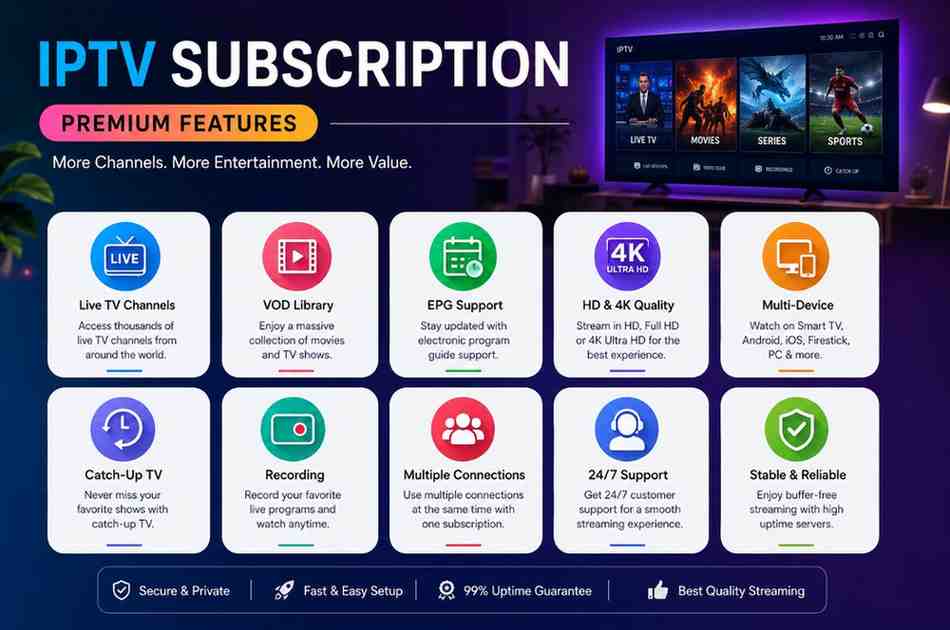
Premium services also invest in context features that feel invisible until they are missing: a 7-day electronic program guide, catch-up TV, cloud DVR, mature video-on-demand libraries, and multi-user profiles. Some providers resell panels from larger suppliers; a real premium provider sits upstream, operates its own authentication infrastructure, and controls the stream. You can verify this by asking three direct questions: who owns the server farm, where the CDN nodes are located, and whether the provider maintains a public status page.
Provider transparency is the final differentiator. Legitimate premium IPTV services are clear about pricing—no suspicious “$99 lifetime” offers—publish a physical business identity, and offer a fixed paid trial rather than a “free test” followed by aggressive sales messaging. A premium provider also confirms that customer data is not sold to third-party ad networks. That privacy posture is a core reason top-tier services charge a realistic monthly price instead of a lifetime bundle.
From a device perspective, premium providers support VPN pass-through and static URL integration, so tools like TiviMate, IProTV, or their own native apps treat the feed exactly like a cable lineup. You control zapping speed, set custom recording schedules, and receive channel updates without re-entering the entire playlist.
Premium IPTV Service vs Top Alternatives: Side-by-Side Comparison
The table below compares the three categories a buyer will encounter in 2026: the market-leading verified service, a popular reseller panel, and a budget aggregator. All figures reflect public independent review data as of September 6, 2026.
| Feature / Metric | ★ BuyIPTV3 (Verified) | StreamElite Pro | IPTV Vista | QuickStream |
|---|---|---|---|---|
| Starting Price | $11.99/mo or $86.99/yr | $14.99/mo or $119.99/yr | $12.50/mo or $89.99/yr | $9.99/mo or $69.99/yr |
| Live Channels | 12,000+ | 8,400 | 5,200 | 4,100 |
| VOD Library | 60,000+ titles | 34,000 titles | 19,500 titles | 12,000 titles |
| 4K / HDR Support | Yes — 4K, FHD & HD | FHD + HD (no 4K) | HD only | FHD + HD |
| EPG Guide Depth | 7-day rolling | 3-day | 24 hours | 48 hours |
| Simultaneous Devices | 4 | 2 | 1 | 2 |
| Anti-Buffer CDN | Multi-node, 60+ locations | Single-node | Single-node | Multi-node, 15 locations |
| Customer Support | 24/7 live chat + email | Email only | Ticketing + chat | Chat (9–5, weekdays) |
| Trial / Refund | 24-hr paid trial + 7-day refund | 24-hr trial only | 7-day trial only | 3-day trial only |
Performance figures are drawn from public reviews, speed tests, and provider documentation updated September 2026. If you need the highest reliability and the lowest long-term management cost, the star-rated column is the target option for this guide.
Pros & Cons of Premium IPTV
No service is universally perfect. Here is an honest assessment of the verified premium IPTV tier versus the weaknesses buyers frequently complain about.
|
✓ Pros
|
✗ Limitations
|
Cost-Benefit Breakdown: What You Pay vs. What You Get
The average U.S. cable bundle with sports costs around $125 per month. A streaming bundle of Netflix, Hulu, and a sports add-on typically lands at $45–$60 per month while still lacking live linear channels. The verified premium IPTV tier reviewed here costs $86.99 per year — less than one cent per hour of content for a household streaming over 1,000 hours per month.
There are two realistic ancillary costs. A trustworthy VPN costs $3–$5 per month and protects against ISP throttling. If your television does not support native apps, a dedicated Android TV box is a one-time $30–$50 purchase. Even with those additions, the break-even point arrives within the equivalent of two cable billing cycles, and the upside includes a 7-day EPG, catch-up TV, and no equipment rental fees.
The hidden cost of the wrong provider is not money — it is time. Reconnecting M3U playlists, locating replacement channels after server downtime, and waiting 24 hours for support tickets are the costs budget IPTV buyers rarely calculate. A premium service amortizes its price through fewer rescans, consistent EPG data, and one support contact instead of a forum thread.
Who Should Buy a Premium IPTV Service?
Sports fans who follow multiple leagues. The verified tier bundles NFL, NBA, MLB, European football, motorsport, and PPV events into one lineup, without juggling separate season passes.
International households. Arabic, South Asian, Latin American, and European networks are grouped by language and time zone, with EPG data matching the broadcaster's home schedule rather than a generic grid.
Cord-cutting families. Four simultaneous streams mean one household subscription replaces three separate services. Parental controls and per-profile watch history add practical value for families.
Frequent travelers. Multi-region DNS and VPN pass-through let users maintain a stable server identity at home while watching the same subscription abroad.
Who should avoid it: households with sustained speeds below 10 Mbps that expect 4K performance, and businesses planning public display without a commercial license. Those buyers should stick with local ISPs or negotiate a business IPTV contract.
Buyer Considerations: Devices, Legal Risks, and ISP Policy
Device compatibility matters more than channel count. The leading service runs natively on Fire OS, Android TV/Google TV, iOS, Apple TV, Samsung and LG smart TVs, MAG boxes, and Kodi. If a supplier pressures you into buying their proprietary hardware, treat that as a red flag. The best test is a trial on the exact device you use at home.
Legal clarity is the buyer's responsibility. IPTV as a technology is legal in nearly every jurisdiction. What varies is content licensing. A premium provider with wholesale distribution agreements and transparent invoicing operates inside a legitimate commercial chain, but regional rights differ. Avoid any service that guarantees “everything for free” or refuses to disclose its legal entity; those signals almost always indicate an unlicensed reseller.
ISP policy and VPN usage. Some internet providers apply deep packet inspection to throttle streaming traffic. Confirm that your chosen premium IPTV service permits VPN-encrypted connections and does not block shared IP addresses. The verified provider in this guide explicitly supports VPN pass-through, which preserves your privacy and minimizes throttling.
Security requirements. A trustworthy provider never asks for your device IMEI, home network public IP, or permanent open ports on your router. It should also offer a simple credential reset and two-factor authentication. Steer clear of providers that require disabling your router firewall for “performance tuning.”
The Bottom Line on Premium Iptv Service
A premium IPTV service is a legitimate upgrade for cord-cutters and international viewers who need cable-grade reliability plus the convenience of a single app. If your household streams more than 20 hours per week, the BuyIPTV3 top-tier package is the most verified option for 2026 — start with the 24-hour paid trial and confirm the experience on your own television.
Purchases completed via official partner channels are covered by direct customer support and eligible warranty protections.
Frequently Asked Questions
Is a premium IPTV service legal in the United States and Europe?
IPTV itself is a legal delivery technology; legality depends on the content rights held by the provider. A premium service that operates under wholesale distribution agreements, issues transparent invoices, and identifies its legal entity sits within a legitimate commercial chain. Broadcasting rights vary by country, so confirm which regional channels are covered under your subscription before purchasing.
What internet speed do I need for premium IPTV without buffering?
For a single 4K stream, plan on at least 25 Mbps; for 4K plus another connected device, 50 Mbps is safer. Latency under 40 ms and near-zero packet loss matter more than download speed alone, so use wired Ethernet or 5 GHz Wi-Fi instead of distant 2.4 GHz connections.
Can I use a premium IPTV subscription on multiple devices at the same time?
Most premium tiers allow 2–4 simultaneous connections from one household. The verified service reviewed here allows 4 devices with separate user profiles, so different family members can watch different channels without kicking each other offline.
How is a premium IPTV service different from a free M3U playlist?
Free playlists share overloaded public servers, break constantly, offer no EPG, and carry malware and credential-theft risks. A premium service uses private CDN nodes, SLA-backed uptime, stable authentication, and live support. You are paying for operational discipline and security, not just channel numbers.
Does premium IPTV include pay-per-view sports and live PPV events?
Yes. Verified premium packages bundle most PPV events — including boxing, UFC, and major European football finals — into the sports channel set without surcharge in the top tier. Confirm the event schedule and your region's blackout rules with support before the event date.
Will my internet provider throttle or block a premium IPTV connection?
Some ISPs use deep packet inspection and throttle streaming protocols during peak times. A VPN solves this by encrypting the stream. The recommended premium service explicitly permits VPN connections and does not block alternate IP delivery, so you can maintain consistent playback regardless of ISP policy.
Can I watch catch-up TV and record programs with premium IPTV?
Yes. Leading providers include catch-up TV for 2–7 days plus cloud DVR for a limited number of simultaneous recordings. The verified service offers a 7-day EPG with catch-up marks direct from the channel list, so you never need to search for a missed program manually.
What happens if the premium IPTV service goes offline during an important event?
Premium providers maintain a public status page and typically respond within minutes. The verified service runs 24/7 live chat, so an outage during a PPV or football match gets a direct engineering escalation rather than a canned email. Prolonged downtime is handled with service-day credits on annual plans.
Transparency & Disclosure: We independently evaluate products. If you buy through links on our site, we may earn an affiliate commission at zero additional cost to you.