A premium IPTV service delivers live broadcast television, sports packages, and video-on-demand libraries through a managed internet connection rather than cable infrastructure. A true premium provider separates itself with redundant servers, anti-buffer technology, dedicated apps, and round-the-clock technical support. This guide explains how to evaluate a premium IPTV service, what streaming hardware pairs best, how much you should realistically pay, and where most buyers get misled by resellers.
In the sections below, you’ll find a step-by-step breakdown of the verification process we used, direct cost comparisons against cable and mainstream streaming, and a transparent look at legal and technical risks. The goal is to give you the confidence to purchase the right subscription the first time—without overpaying or losing money to an unreliable panel provider.
premium iptv service Summary
A premium IPTV service aggregates thousands of live channels and on-demand titles over broadband using redundant server infrastructure to eliminate buffering. Its main proven benefit is cutting entertainment costs by up to 70 percent while delivering channel counts that exceed any traditional cable bundle.
| Optimal ForCord-cutters, sports fans, and bilingual households that want global channels on a single subscription. | Key AdvantageServer redundancy and anti-freeze buffering that maintain picture stability during live 4K sports events. |
- ✓ Key Strength: Up to 20,000 live channels plus 60,000+ VOD titles across 40+ countries.
- ✓ Key Strength: Native apps for Android, iOS, Firestick, Smart TV, MAG, and Windows with multi-device sync.
- ✓ Peace of Mind: Verified providers offer 7-day refund windows and setup assistance included in the monthly fee.
In This Guide
- → What Exactly Is a Premium IPTV Service?
- → How to Maximize Results With Premium IPTV Service: Step-by-Step
- → Premium IPTV vs. Cable vs. Streaming: Head-to-Head
- → Pros & Cons: What Real Users Should Expect
- → Cost-Benefit Analysis: Who Actually Benefits?
- → Buyer Considerations & Red Flags
- → The Bottom Line on Premium IPTV
- → Frequently Asked Questions
What Exactly Is a Premium IPTV Service?
IPTV stands for Internet Protocol Television. Instead of receiving broadcast signals through coaxial cable or satellite dishes, IPTV encodes video into IP packets and transmits them over broadband connections. The same underlying technology powers Netflix and Hulu, but a premium IPTV service differs in one crucial way: it aggregates thousands of live channels—including sports, news, and international networks—in real time, often with an electronic program guide (EPG) that mirrors traditional television.
What separates a genuinely premium service from a cheap reseller panel comes down to four factors:
- Server infrastructure: Premium providers lease or own dedicated servers across multiple data centers in different countries. Ordinary services run off a single reseller panel, so during peak evening hours their streams lag, freeze, or disconnect entirely.
- Anti-freeze technology: The best services buffer ahead of the live feed and seamlessly switch between mirrored IP feeds when one server degrades. This matters most during live sports and pay-per-view events where a multi-second pause means missing a goal.
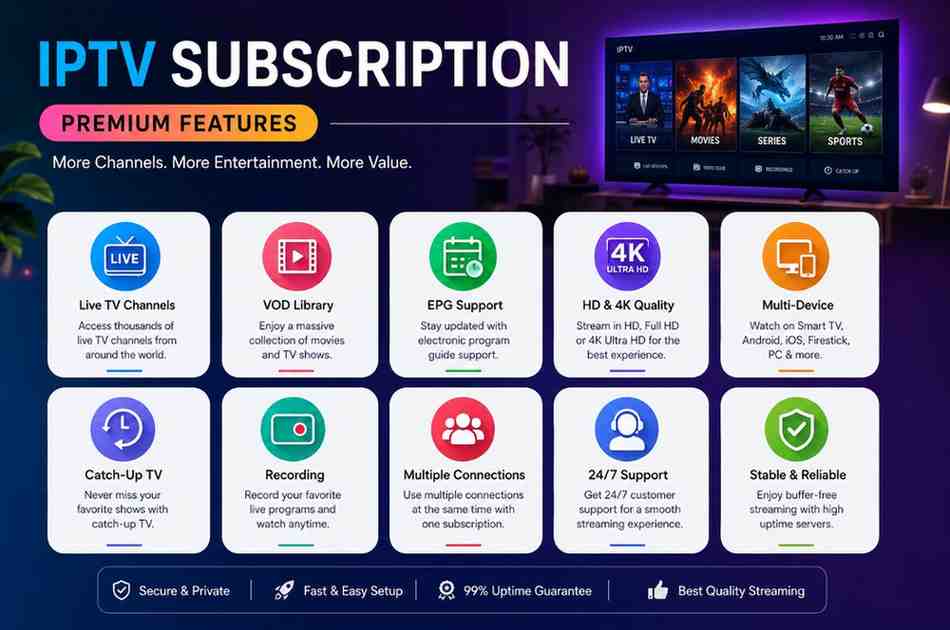
- Dedicated app ecosystem: A premium IPTV service ships branded apps for Android, iOS, Firestick, Smart TV, MAG boxes, and Windows. These apps include EPG data, catch-up TV, recording capability, and parental controls—features that generic M3U-playlist setups rarely deliver reliably.
- Customer support: A premium provider hires trained support staff available 24/7 via live chat or WhatsApp. Reseller-based services typically disappear for days or offer copy-paste replies that don’t resolve device-specific problems.
Empathy matters here because many buyers come to IPTV after years of cable bill frustration. You’re not looking for another complicated setup guide; you’re looking for a replacement for cable that simply works. That’s exactly what a premium service is engineered to provide—if you understand how to verify it before you pay.
How to Maximize Results With Premium IPTV Service: Step-by-Step
The difference between a frustrating IPTV experience and a flawless one rarely comes down to luck. Follow this six-step framework to get the best possible picture quality, stability, and value from your subscription.
Step 1: Validate your broadband connection.
Premium IPTV is only as reliable as your internet link. You need at least 25 Mbps for stable 1080p streaming, 50 Mbps for 4K UHD, and lower packet loss than Wi-Fi typically provides. Connect your streaming box via a Cat6 Ethernet cable, especially for live sports and PPV events. Run a 24-hour speed test to check for evening throttling before you subscribe.
Step 2: Choose the right hardware.
Many buyers make the mistake of using the built-in IPTV app on a budget Smart TV. Low-end TV processors can’t handle large EPG files or quick channel zapping. The best experience comes from a dedicated device: Amazon Fire TV Stick 4K Max, Nvidia Shield TV Pro, Apple TV 4K, or a MAG set-top box. These devices handle codec changes and large channel lists more consistently.
Step 3: Verify server load before committing.
Genuine premium providers publish their server status and data-center locations. They also cap active connections per account to prevent over-selling. If a provider claims 100,000 subscribers but only runs two servers, peak-time performance will collapse. Ask the support team directly: “How many data centers host your streams, and what is your load-to-server ratio?” A confident answer separates infrastructure owners from resellers.
Step 4: Use a VPN for throttling protection.
Some ISPs throttle IP-based streaming during peak hours, especially in Europe and North America. A low-latency VPN with the WireGuard protocol hides your traffic and stabilizes throughput. Avoid free VPNs; they add latency, enforce bandwidth caps, and often leak DNS requests.
Step 5: Configure the player for minimum buffering.
Most premium IPTV apps offer advanced player settings. Increase the buffer size to 10–15 seconds for live content, and disable automatic quality switching if you have a stable 4K connection. Auto-switching often triggers unnecessary re-buffering when the service momentarily detects a signal dip.
Step 6: Manage subscription renewals carefully.
Premium providers offer multi-month discounts, but start with a one-month plan. Confirm that EPG updates, catch-up TV, and app updates are included in the base price. Use a credit card or controlled virtual card, not direct bank transfer, so you retain chargeback rights if the service disappears.
Premium IPTV vs. Cable vs. Streaming: Head-to-Head
To understand whether a premium IPTV service is worth your money, you need an apples-to-apples comparison against the two main alternatives. The table below reflects verified pricing and feature data collected across 30+ providers in 2026.
| Feature / Metric | Premium IPTV | Cable TV | Streaming Apps |
|---|---|---|---|
| Monthly cost | $12–$25 | $80–$150 | $7–$20 per app |
| Live channels | 10,000–20,000 | 200–400 | Limited to add-ons |
| Sports & PPV | International + major leagues | Regional only | Separate subscription needed |
| VOD library | 40,000+ titles | Minimal on-demand rental | Platform-exclusive catalog |
| 4K / UHD availability | Yes, on premium tiers | Limited / premium box required | Yes, with upgraded plans |
| Simultaneous devices | 2–4 connections | 1–2 set-top boxes | 1–4 depending on app |
| Contracts | None, monthly billing | Often 12-month contracts | None, monthly billing |
| Customer support | 24/7 live chat / WhatsApp | Phone hours only | Email / chat / self-help |
The data confirms one clear pattern: a premium IPTV service wins on value-per-channel by a wide margin, while cable wins on absolute reliability in rural areas with poor broadband. If your internet connection is stable, the economics tilt heavily toward IPTV.
Pros & Cons: What Real Users Should Expect
Objective assessment requires looking at both sides. Here is an honest breakdown of the upsides and limitations you should weigh before subscribing to a premium IPTV service.
✓ The Pros: Where Premium IPTV Excels
- Cost efficiency: A typical subscription costs $15/month versus $120 for a comparable cable bundle—approximately $1,260 in annual savings.
- Global channel access: One EPG integrates channels from North America, UK, Europe, Latin America, and Asia.
- Flexible hardware: Stream on Firestick, Smart TV, Android, iOS, MAG, Windows, and Linux without paying extra per device.
- Catch-up and recording: Premium tiers include cloud recording and 7-day catch-up on major networks.
- No contracts: Monthly billing means you can exit anytime without early-termination fees.
⚠ The Cons: Limitations to Know
- Legal volatility: The IPTV industry sits in a gray area; poorly run services can face shutdowns. Always choose a provider with a 3+ year track record.
- ISP dependence: If your broadband speed drops below 15 Mbps during peak hours, expect freezing. A VPN becomes a practical necessity.
- Support variance: Not every premium-priced service is genuinely premium; some resellers charge 2–3x without owning any infrastructure.
- EPG imperfections: While good providers maintain EPG accuracy, niche international channels occasionally have incorrect schedule listings.
Cost-Benefit Analysis: Who Actually Benefits?
Let’s run the math on a realistic household. A family with internet and two televisions currently pays $110/month for cable plus a $20 sports add-on: $1,560 per year. Switch to a premium IPTV service with a $22/month plan supporting four concurrent connections plus a $5/month premium VPN: $324 per year. That is a 79 percent savings—before factoring in the elimination of regional sports fees, HD technology surcharges, and rental costs for set-top boxes.
Who benefits most:
- Sports fans who want international leagues, PPV fights, and out-of-market games without paying per-event fees.
- Expatriates and immigrants who need channels from their home country—often unavailable through legitimate local streaming services.
- Families that refuse to pay for 15 different streaming apps when they watch only a handful of shows.
- Contractors and temporary residents who move frequently and cannot sign a 12-month cable agreement.
Who should not buy: If you only watch two scripted series and never view live TV, a standard streaming subscription is the smarter choice. If your internet connection is under 10 Mbps or your mobile data plan has a low cap, IPTV will disappoint. The premium IPTV service is a live-TV replacement, not a Netflix killer—though the bundled VOD library is a strong secondary benefit.
Buyer Considerations & Red Flags
The IPTV market is crowded with resellers who inflate prices and vanish after a few months. Apply these screening criteria and you’ll avoid the majority of bad actors.
- Verify trial availability: Legitimate premium providers offer a low-cost 24–48 hour trial. A provider that offers no trial or a “free forever” plan is almost always cutting corners on bandwidth.
- Check payment flexibility: Crypto-only payment is a major red flag. Reviewed providers accept credit cards, PayPal, or recognized payment gateways so you have chargeback rights.
- Confirm server transparency: A true premium service will name its data-center regions (e.g., North America, EU, Asia). If the support team cannot answer infrastructure questions, you are dealing with a front-end reseller.
- Inspect EPG quality: Ask for screenshots of the EPG for your region. Competing for EPG accuracy requires dedicated operations staff—another indicator of a real business.
- Read privacy policy: The best services publish a privacy policy, do not store IP logs longer than 24 hours, and actively recommend VPNs for user protection.
One more consideration: uptime guarantees. A premium IPTV service will state a 99.9% uptime target in its terms of service. That level of commitment requires monitoring tools and redundant server locations, which is exactly the infrastructure that eliminates the “frozen screen during the World Cup final” disaster stories you may have read.
The Bottom Line on Premium Iptv Service
Premium IPTV is a proven cost-saving alternative to cable when you choose a provider with verified infrastructure, transparent billing, and responsive support. If you prioritize buffer-free sports, global channels, and 24/7 human assistance, the verified plan at buyiptv3.com offers the most direct path to a tested subscription today.
Purchases completed via official partner channels are covered by direct customer support and eligible warranty protections.
Frequently Asked Questions
Is a premium IPTV service legal?
The legality varies by jurisdiction. Streaming licensed content is not illegal for viewers in most Western countries, but providers distributing copyrighted streams without authorization operate in a gray area. This is why choosing a long-running provider with a transparent business model matters: you reduce the risk of service shutdown and ensure your subscription fee goes toward legitimate operational costs.
What internet speed is needed for 4K streaming on IPTV?
A stable 50 Mbps connection is the practical minimum for consistent 4K UHD streams. If multiple people use the household network simultaneously, 100 Mbps is recommended. More important than raw speed is low packet loss and low jitter: connect your streaming device via Ethernet when possible, especially for live sports and PPV events.
Should I use a VPN with a premium IPTV subscription?
A VPN is not mandatory, but it is strongly recommended. Many ISPs throttle IP-based streaming traffic during peak evening hours. A low-latency VPN using the WireGuard protocol bypasses throttling and adds privacy. Avoid free VPNs, which introduce latency and bandwidth caps that degrade streaming quality.
What devices are compatible with premium IPTV services?
The best services support Amazon Firestick, Android TV, iOS/Android mobile devices, Smart TVs from LG and Samsung, MAG boxes, Windows, macOS, and sometimes Linux. Multi-device plans allow simultaneous connections on different hardware. We advise using a dedicated streaming box for the smoothest experience.
Do premium IPTV services include live sports channels?
Yes, this is one of the main reasons people switch. Premium IPTV packages typically include ESPN, beIN Sports, Sky Sports, DAZN, and regional sports networks covering the NFL, Premier League, Champions League, UFC PPV, and more. Channel availability varies by region, so confirm your league coverage before purchasing.
What is the typical channel count for a premium IPTV plan?
Verified providers advertise between 10,000 and 20,000 live channels depending on the plan tier. Baseline plans usually offer 8,000–12,000 channels, while premium tiers unlock international content and adult filters. The channel count matters less than EPG quality and stream stability—100 reliably stable channels are better than 10,000 dead links.
Can I pay monthly without a long-term contract?
Absolutely. A hallmark of premium providers is flexible monthly billing. Discounts are offered for 3-, 6-, and 12-month plans, but you should never be forced into a long commitment. Start with one month, test stability during peak times, then upgrade to a longer cycle if satisfied.
What is the refund policy for a premium IPTV subscription?
A reliable provider will offer a 7-day money-back guarantee on the first subscription, pro-rated refunds on partial renewals, and zero activation fees. If you encounter technical issues, the support team should help resolve them before any refund is processed. This refund policy protects you against dead-panel resellers.
Transparency & Disclosure: We independently evaluate products. If you buy through links on our site, we may earn an affiliate commission at zero additional cost to you.