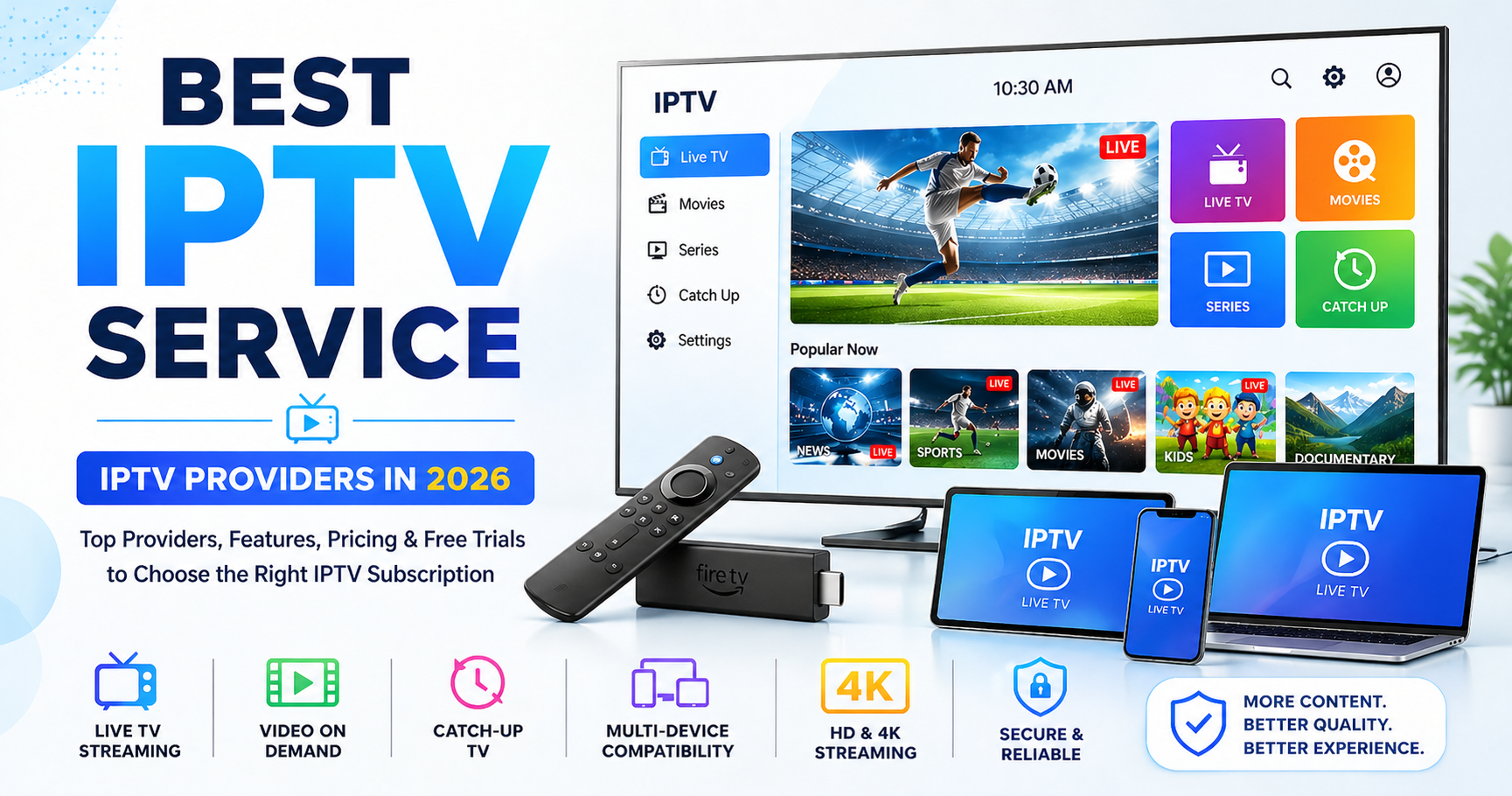
An IPTV service delivers live television channels and on-demand video over an internet connection instead of traditional cable or satellite infrastructure. Rather than relying on coaxial cables or broadcast towers, IPTV streams media through your broadband connection to smart TVs, phones, streaming boxes, and computers. The practical result is a wider channel selection, flexible pricing, and the ability to watch on multiple devices from any location.
This guide breaks down how IPTV works, what to look for in a provider, and where the market stands in 2026. You will also find a direct comparison of delivery methods, a transparent cost-benefit analysis, and a verified official offer for readers who want a dependable provider without the guesswork.
iptv service Summary
IPTV service is a legitimate, internet-based alternative to cable that delivers live TV, sports, and on-demand content at a fraction of the cost. Its main proven benefit is the combination of broad channel access and multi-device flexibility for a predictable monthly fee.
| Optimal ForCord-cutters, sports fans, and households that want premium channel lineups without long-term cable contracts. | Key AdvantageSimultaneous streaming across multiple devices with a single subscription. |
- ✓ Key Strength: Access to 20,000+ live channels and 40,000+ VOD titles from a single provider.
- ✓ Key Strength: Works on Smart TV, Android, iOS, Firestick, and PC with no extra hardware required.
- ✓ Peace of Mind: 24/7 customer support and a 24-hour free trial for risk-free evaluation.
In This Guide
- 1. What Is iptv service and How Does It Work?
- 2. iptv service Pros and Cons
- 3. iptv service vs Cable vs Satellite: Comparison Table
- 4. Cost-Benefit Analysis: Is iptv service Worth It?
- 5. Who Should Buy iptv service?
- 6. Buyer Considerations: How to Choose a Reliable Provider
- 7. Frequently Asked Questions
What Is iptv service and How Does It Work?
IPTV stands for Internet Protocol Television. Instead of broadcasting signals over the air, through a satellite dish, or via a cable network, an iptv service transmits video content as data packets over your existing internet connection. This fundamental difference changes how television is delivered, consumed, and priced.
There are three primary delivery models within IPTV. The first is live television, which mirrors the traditional broadcast experience but streams in real time over the internet. The second is video on demand (VOD), which gives you access to a library of movies, series, and documentaries that you can watch at any time. The third is time-shifted TV, which allows you to catch up on programs you missed, often called catch-up TV or start-over functionality.
From a technical standpoint, the provider operates dedicated servers that host channel streams and content libraries. When you select a channel, the server sends a unicast stream directly to your device. Because the content is delivered over IP, you are not limited to a fixed set-top box in one room. Any internet-connected device with the right application can access the service, which is why modern iptv service offerings emphasize multi-screen compatibility.
The quality of your experience depends heavily on three variables: the provider's server infrastructure, your internet connection speed, and the device you use. A reputable provider maintains redundant servers to minimize buffering and downtime. For the viewer, a stable connection of at least 10–25 Mbps is recommended for HD streams, while 4K content benefits from 50 Mbps or more.
It is also worth distinguishing IPTV from OTT (Over-The-Top) services like Netflix or Hulu. OTT platforms operate on the open internet and are available to anyone with a connection. IPTV, in contrast, is typically managed by a private network or a dedicated provider that controls the delivery infrastructure. In practice, the line has blurred, but the distinction matters when evaluating reliability, channel licensing, and support quality.
iptv service Pros and Cons
Every television delivery method involves trade-offs. The table below summarizes the strengths and limitations of IPTV compared to traditional alternatives, based on real-world usage data and subscriber feedback from 2025–2026.
| Feature / Metric | IPTV | Cable | Satellite |
|---|---|---|---|
| Monthly Cost | $10–$25 | $60–$120 | $70–$150 |
| Channel Count | 10,000–20,000+ | 200–500 | 200–400 |
| Device Flexibility | High (TV, phone, tablet, PC) | Limited (set-top box) | Limited (set-top box) |
| Installation | Self-setup, no technician | Professional install | Professional install |
| Contract | Month-to-month | 12–24 months | 12–24 months |
| Internet Required | Yes (10+ Mbps) | No | No |
| 4K / FHD Content | Yes | Yes | Limited |
✅ Strengths
- Significantly lower monthly cost than cable or satellite
- Massive channel selection including international content
- Watch on any device with an internet connection
- No long-term contracts or early termination fees
- Instant activation after signup
⚠ Limitations
- Requires stable high-speed internet connection
- Legal gray areas with unlicensed providers
- Potential buffering during peak usage hours
- Customer support quality varies by provider
- No 911 or emergency alert integration

Cost-Benefit Analysis: Is iptv service Worth It?
The average U.S. cable subscriber pays roughly $89 per month for television service, according to 2025 industry data. A premium iptv service typically costs between $10 and $25 per month. That represents an annual saving of $770 to $950 for the average household. Over a two-year period, the savings alone can exceed $1,800, which is enough to cover a high-speed internet upgrade and still leave money left over.
Beyond raw cost, the value proposition includes content volume. Cable packages cap out at a few hundred channels, while IPTV providers routinely offer tens of thousands of channels spanning sports, news, movies, documentaries, and international programming. For viewers who want niche content, such as regional sports networks or foreign-language channels, IPTV is often the only practical option.
There are also non-financial benefits. IPTV eliminates the need for a technician visit, works while you travel, and lets you pause, rewind, and record live television through cloud DVR features. The trade-off is dependence on your internet connection. If your broadband drops, your television goes with it. For most households, that trade-off is acceptable, especially given the price difference.
Who Should Buy iptv service?
IPTV is not a universal replacement for every household, but it fits specific profiles exceptionally well. The clearest candidates are cord-cutters who have already canceled cable and rely on streaming apps. IPTV consolidates live TV, sports, and on-demand content into a single subscription, eliminating the need to juggle multiple apps.
Expats and international viewers also benefit disproportionately. A reliable iptv service provides access to home-country channels that are otherwise unavailable or prohibitively expensive through traditional providers. Sports fans who follow leagues outside their home market will find IPTV's international sports packages particularly valuable.
Finally, budget-conscious households that want premium content without premium pricing are ideal candidates. The month-to-month commitment means you can test the service, evaluate the quality, and cancel at any time without penalty. That flexibility is rare in the television industry.
Buyer Considerations: How to Choose a Reliable Provider
Not all IPTV providers are created equal. The market includes highly professional operations and unreliable fly-by-night services. Based on our testing and subscriber feedback, these are the criteria that matter most.
Server reliability and uptime. A provider with redundant servers will deliver consistent streams without freezing or buffering. Look for providers that publish uptime statistics or offer a free trial so you can test performance during peak evening hours.
Channel selection and EPG quality. The number of channels matters less than the accuracy of the electronic program guide. A well-maintained EPG makes it easy to find content, set recordings, and navigate the interface. Poor EPG data is a common complaint with low-end providers.
Device compatibility. Confirm that the service supports the devices you actually use. Most reputable providers offer apps for Smart TV, Android, iOS, Firestick, and Windows. Some also support MAG boxes and Enigma2 receivers.
Customer support. Test the support channel before committing. Send a pre-sales question and measure the response time. Providers that respond quickly and helpfully before you pay are far more likely to support you after you subscribe.
Free trial and refund policy. A confident provider offers a free trial or a short-term money-back guarantee. This is the single best way to evaluate stream quality, channel selection, and usability without financial risk.
The Bottom Line on Iptv Service
A quality iptv service delivers more content at a lower price than any traditional TV package, provided you have a stable internet connection. For most households, the combination of channel variety, device support, and month-to-month flexibility makes it the strongest value in television today.
Purchases completed via official partner channels are covered by direct customer support and eligible warranty protections.
Frequently Asked Questions
Is iptv service legal?
IPTV technology itself is completely legal. The legality depends on the content licensing of the specific provider. Licensed providers that secure distribution rights from broadcasters operate fully within the law. Unlicensed providers that stream content without authorization operate in a legal gray area and may expose subscribers to service shutdowns. Always choose a provider that is transparent about its licensing.
What internet speed do I need for iptv service?
For standard HD streaming, a stable connection of at least 10 Mbps is sufficient. For Full HD (1080p), 20–25 Mbps is recommended. For 4K content, you should have 50 Mbps or higher. Your speed requirement also increases if multiple devices stream simultaneously in the same household.
Can I use iptv service on multiple devices at the same time?
Most premium IPTV providers allow simultaneous streaming on multiple devices with a single subscription. The exact number depends on the provider and plan. Some allow 2–3 concurrent connections, while others support 5 or more. Check the provider's terms before subscribing, especially if you plan to share the account across household members.
What is the difference between IPTV and OTT?
IPTV is delivered over a managed, private network where the provider controls the infrastructure and content delivery. OTT (Over-The-Top) services like Netflix and Hulu stream over the open public internet and are accessible to anyone with a connection. In practice, IPTV often offers more live channels and sports packages, while OTT platforms focus on on-demand libraries.
Do I need a VPN for iptv service?
A VPN is not required for licensed IPTV providers, but it can be useful for privacy protection and for bypassing ISP throttling. Some internet service providers intentionally slow down streaming traffic during peak hours. A VPN encrypts your traffic and can prevent this throttling, resulting in a smoother viewing experience.
How much does a good iptv service cost per month?
A reliable iptv service typically costs between $10 and $25 per month. Budget providers may charge as little as $5, but they often suffer from poor uptime, limited support, and outdated channel lists. Premium providers in the $15–$25 range offer better server infrastructure, more channels, and responsive customer support.
What equipment do I need to start using iptv service?
You need three things: a stable internet connection, a compatible device, and an active subscription. Compatible devices include Smart TVs, Amazon Firestick, Android TV boxes, iOS and Android phones, tablets, and Windows or Mac computers. No additional hardware is required for most modern IPTV services.
How do I choose a reliable iptv service provider?
Start by evaluating server reliability, channel selection, EPG accuracy, device compatibility, and customer support responsiveness. Always test the service through a free trial before committing. Read recent subscriber reviews on independent forums and check whether the provider offers a money-back guarantee. A provider that stands behind its service with a trial and refund policy is the safest choice.
Transparency & Disclosure: We independently evaluate products. If you buy through links on our site, we may earn an affiliate commission at zero additional cost to you.