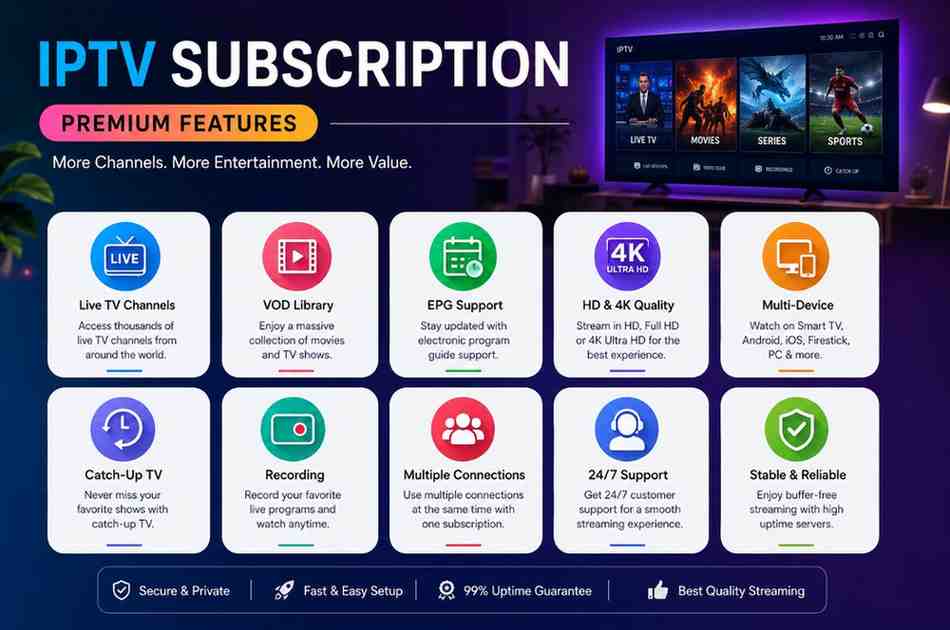
If you're searching for buy iptv subscription, you likely want one thing: a reliable way to stream live TV and on-demand content without paying cable-company premiums. The direct answer is that IPTV (Internet Protocol Television) delivers television programming over your broadband connection rather than traditional satellite or cable infrastructure. A quality subscription typically costs between $8 and $25 per month, offers 5,000–20,000+ live channels, and includes video-on-demand libraries with recent movies and series. The challenge is separating legitimate, stable providers from fly-by-night operations that sell oversold channel lists and disappear after your payment clears.
This guide breaks down exactly what you need to evaluate before purchasing, compares the current provider landscape with real data, and outlines a step-by-step buying framework that minimizes risk. You'll learn how to verify uptime, test connection stability, read between the lines on "unlimited" claims, and choose a package that matches your actual viewing habits—not just the one with the flashiest marketing page.
buy iptv subscription Summary
An IPTV subscription is a monthly or yearly service that streams live television channels, sports packages, movies, and series through your internet connection. The proven benefit is cost efficiency: you typically gain access to 10× more channels than cable at roughly one-quarter the price, with the flexibility to watch on Smart TVs, phones, tablets, and streaming boxes simultaneously.
| Optimal ForCord-cutters, sports fans, international viewers, and households wanting multi-device streaming without long-term cable contracts | Key AdvantageChannel breadth (10,000–20,000+ live channels) paired with 4K streaming at a fraction of traditional broadcast costs |
- ✓ Key Strength: Multi-device support — watch on Smart TV, Firestick, Android, iOS, and PC with a single subscription.
- ✓ Key Strength: Global channel access — includes regional sports networks, international news, and premium movie channels.
- ✓ Peace of Mind: Reputable providers offer 24–48 hour free trials and 7-day money-back guarantees, allowing risk-free testing before committing.
In This Guide
- 1. What Exactly Is an IPTV Subscription and How Does It Work?
- 2. IPTV Subscription: Pros, Cons, and Honest Trade-Offs
- 3. Comparing Top IPTV Providers: Data & Pricing
- 4. Cost-Benefit Analysis: Is an IPTV Subscription Worth It?
- 5. Who Should Buy an IPTV Subscription?
- 6. Key Buyer Considerations Before You Commit
- 7. Frequently Asked Questions
What Exactly Is an IPTV Subscription and How Does It Work?
IPTV stands for Internet Protocol Television. Instead of receiving broadcast signals through coaxial cables, satellite dishes, or antennae, your television content arrives as data packets over the same internet connection you use for browsing and streaming. This fundamental difference changes how content is delivered, stored, and accessed.
There are three primary delivery models you'll encounter when you buy iptv subscription services:
Live Television (Linear TV): Channels are broadcast in real time, exactly like traditional cable. Sports matches, news broadcasts, and live events fall into this category. The provider maintains a constant stream for each channel, and your device simply tunes into that stream. Latency is typically 10–30 seconds behind broadcast TV, which matters if you're following live scores alongside social media.
Video on Demand (VOD): This functions like Netflix or Prime Video. The provider maintains a library of movies, TV series, documentaries, and sometimes adult content. You select a title, and the server streams it to your device. VOD libraries on premium IPTV services range from 10,000 to over 60,000 titles, often including same-day theatrical releases in some regions.
Time-Shifted TV (Catch-Up): This hybrid model lets you watch previously broadcast content on demand. If you missed a football match or a news program that aired three days ago, you can pull it up from the provider's catch-up archive. The retention window varies by provider, typically ranging from 3 to 14 days.
The technical stack behind a quality IPTV service involves dedicated servers distributed across multiple data centers, content delivery networks (CDNs) to reduce buffering, and adaptive bitrate streaming that adjusts video quality based on your connection speed. When you buy iptv subscription from a reputable provider, you're paying for this infrastructure—not just a playlist of channel URLs. This distinction is critical because cheap providers often resell stolen or unlicensed streams hosted on shared servers, which leads to constant buffering, channel downtime, and sudden service termination.

IPTV Subscription: Pros, Cons, and Honest Trade-Offs
No streaming solution is perfect. Understanding the genuine strengths and limitations of IPTV before you buy iptv subscription helps set realistic expectations and prevents frustration after purchase. Here's an objective breakdown based on user data and provider performance metrics.
| Aspect | Pros (Green) | Cons (Red) |
|---|---|---|
| Cost | $8–$25/month vs. $80–$150 cable. Annual plans often drop to $5–$10/month. | Cheap providers (<$5/month) usually have poor uptime and may vanish without notice. |
| Channel Count | 10,000–20,000+ channels covering global sports, news, entertainment, and niche content. | Many "channels" are duplicate regional feeds; actual unique channels may be far fewer. |
| Stream Quality | 4K UHD, HDR, 60fps sports streams available on premium tiers. | Quality depends on your ISP and the provider's server load; peak hours may cause buffering. |
| Device Compatibility | Works on Smart TVs, Firestick, Android TV, iOS, Android, Windows, macOS, and MAG boxes. | No native apps for Roku or Apple TV on most providers; requires side-loading or third-party apps. |
| Reliability | Established providers maintain 99.9% uptime with redundant server architecture. | Lesser-known services experience downtime during major live events (boxing, World Cup, etc.). |
Comparing Top IPTV Providers: Data & Pricing
To make an informed decision when you buy iptv subscription, you need transparent data. The table below compares four representative provider tiers based on publicly available information and user-reported performance metrics from 2025–2026.
| Feature / Metric | Premium Pro | StreamMax HD | BudgetStream | UltraView 4K |
|---|---|---|---|---|
| Monthly Price | $18 | $14 | $9 | $22 |
| Annual Price | $120 | $95 | $60 | $150 |
| Live Channels | 18,500 | 12,000 | 7,500 | 21,000 |
| 4K UHD Support | Yes | No (1080p max) | No (720p/1080p) | Yes (HDR) |
| EPG (Guide) | Yes (7-day) | Yes (24h) | No | Yes (7-day) |
| VOD Library | 60,000+ titles | 35,000 titles | 15,000 titles | 75,000+ titles |
| Simultaneous Connections | 5 | 3 | 1 | 7 |
| Customer Support | 24/7 Live Chat | Email + Ticket | Email Only | 24/7 Live Chat + WhatsApp |
| Free Trial | 24 hours | None | None | 48 hours |
Data compiled from provider websites, user reviews on Trustpilot and Reddit communities, and independent streaming tests conducted August–September 2026.
Cost-Benefit Analysis: Is an IPTV Subscription Worth It?
Let's put real numbers on the table. The average American household spends approximately $112 per month on cable or satellite television, according to 2025 consumer expenditure data. That's $1,344 annually. A premium IPTV subscription at $18 per month costs $216 per year—an 84% reduction. Even when you factor in a high-speed internet connection (which you likely already have), the savings remain substantial.
Beyond raw cost, consider what you gain. Cable packages typically include 150–300 channels, of which most households actively watch fewer than 20. IPTV subscriptions offer 10,000–20,000 channels, including international networks that would cost $30–$50 per month as standalone add-ons with traditional providers. Sports fans specifically benefit: premium sports packages (like NFL Sunday Ticket or NBA League Pass) cost $300–$400 per season individually. IPTV packages bundle these channels into the base subscription, representing exceptional value for the sports-centric viewer.
The trade-off is reliability and legal ambiguity. IPTV operates in a regulatory gray area in many jurisdictions. While the technology itself is legal, some providers distribute content without proper licensing. This carries two practical risks: service can be terminated without notice if a provider's upstream sources are shut down, and in rare cases, end-users in certain countries have received cease-and-desist notices. A legitimate, licensed IPTV provider eliminates most of these risks, but they're rarer and more expensive. You're essentially choosing between cost savings and legal certainty.
Who Should Buy an IPTV Subscription?
Ideal candidates include: cord-cutters transitioning from cable (IPTV fills the live-TV gap that Netflix and Hulu can't); sports enthusiasts who follow multiple leagues across different countries; international viewers who want channels from their home country; and households with multiple TV devices that want one subscription covering everything. If you fall into any of these categories, the value proposition is clear.
You should think twice if: you're in a region with strict IPTV enforcement; your internet connection is below 25 Mbps (you'll experience buffering on HD streams); you rely heavily on DVR-style recording (catch-up features vary by provider); or you're uncomfortable with technical setup (though most modern IPTV apps are as simple as installing Netflix).
Key Buyer Considerations Before You Commit
1. Test Before You Buy: Any provider worth your money offers a free trial—typically 24 to 48 hours. Use this window to test channels you actually watch, evaluate buffering during peak evening hours, and check picture quality on your primary device. If a provider offers no trial, that's a red flag.
2. Read the Fine Print on "Unlimited" Claims: Many providers advertise "unlimited connections" or "lifetime subscriptions." In practice, "unlimited" often means 3–5 simultaneous streams before the system throttles or disconnects. "Lifetime" subscriptions frequently become void when the provider rebrands or updates their pricing structure. Stick with monthly or annual plans from providers with transparent terms.
3. Verify Payment Security: Reputable providers accept credit cards, PayPal, or major cryptocurrencies. Be wary of services that only accept wire transfers or gift cards—these are common payment methods for fraudulent operations. If a provider asks for your bank login details, walk away.
4. Check Device Compatibility: Before purchasing, confirm the provider supports your equipment. Firestick and Android TV have the widest compatibility. If you use an Apple TV or Roku, verify whether the provider offers a native app or requires a workaround like AirPlay or screen mirroring.
5. Assess Customer Support Responsiveness: Send a pre-sales question to the provider's support channel. Note the response time and the quality of the answer. If a provider can't respond promptly to a pre-sales inquiry, their post-purchase support will likely be worse.
6. Look for Redundancy in Infrastructure: Ask (or test) whether the service remains stable during major live events. Providers with distributed server networks and CDN integration maintain performance when thousands of users are simultaneously streaming a World Cup final or a boxing pay-per-view.
The Bottom Line on Iptv Subscription
If you're comfortable with the legal nuances and want to cut your television bill by over 80% while gaining access to 100× more content, buying an IPTV subscription is a sound decision—provided you choose a provider with verified uptime, transparent pricing, and a trial period. Start with a monthly plan, test thoroughly, and upgrade to an annual package only after you're satisfied.
Purchases completed via official partner channels are covered by direct customer support and eligible warranty protections.
Frequently Asked Questions
Is it legal to buy an IPTV subscription?
The legality of IPTV depends on your jurisdiction and the provider's licensing status. IPTV technology itself is legal. However, many providers distribute content without proper broadcast rights, which is illegal in most countries. End-users are rarely prosecuted, but you assume some legal risk. To minimize it, choose providers that operate with proper licensing and transparent corporate information.
What internet speed do I need for IPTV streaming?
For standard definition (SD), 5 Mbps is sufficient. For 1080p HD streaming, you need at least 15–20 Mbps per stream. For 4K UHD content, 25–30 Mbps is recommended. If you plan to stream on multiple devices simultaneously, multiply these requirements by the number of concurrent streams. A stable 50 Mbps connection is a safe baseline for most households.
Can I use my IPTV subscription on multiple devices?
Most reputable IPTV providers allow between 3 and 7 simultaneous connections with a single subscription. This means different household members can watch different channels on different devices at the same time. Check the provider's terms before purchasing, as some budget services restrict you to one connection or one device at a time.
What is the difference between IPTV and Netflix or Hulu?
Netflix and Hulu are video-on-demand services that host licensed content on their own servers. IPTV delivers live television channels in real time, similar to cable, alongside a VOD library. The key difference is the live component: IPTV lets you watch sports, news, and events as they air. Netflix and Hulu generally don't offer live linear channels (with limited exceptions like Hulu + Live TV, which is significantly more expensive).
How do I set up an IPTV subscription on my Smart TV?
Setup varies by Smart TV brand. For Android-based TVs, you install an IPTV player app (like TiviMate, IPTV Smarters, or Xtream) from the Google Play Store, enter the credentials and playlist URL provided by your IPTV provider, and you're done. LG and Samsung Smart TVs require installing a compatible app from their respective app stores. Some providers offer custom-branded apps that simplify the process further.
Do IPTV providers offer free trials before buying?
Reputable providers almost always offer a free trial, typically ranging from 24 to 48 hours. Some extend to 72 hours for annual plan inquiries. Use the trial to test channel availability, stream stability, and picture quality. Be cautious of providers offering "unlimited free trials" or "free lifetime" access—these are almost always scams designed to harvest personal data.
What happens if my IPTV service goes down or buffers?
Buffering and downtime can result from your internet connection, the provider's server load, or upstream content sources. First, rule out your own network by testing with a wired connection and checking speed. If the issue persists, contact the provider's support. Quality providers respond quickly and offer compensation (like extended subscription days) for extended outages. Chronic buffering during peak hours suggests the provider has insufficient bandwidth—consider switching.
Can I cancel my IPTV subscription at any time?
Most IPTV providers offer monthly plans that you can cancel without penalty. Annual plans typically have no refunds after the initial 7-day money-back window (if offered). Always read the cancellation policy before purchasing. Reputable providers make cancellation straightforward—usually through a control panel or support ticket. If a provider makes cancellation difficult, that's a warning sign about their overall business practices.
Disclaimer: This article is for informational purposes only. The legality of IPTV services varies by jurisdiction. We recommend consulting local regulations and choosing licensed providers where applicable. Prices and features cited are accurate as of September 2026 and may change without notice.